
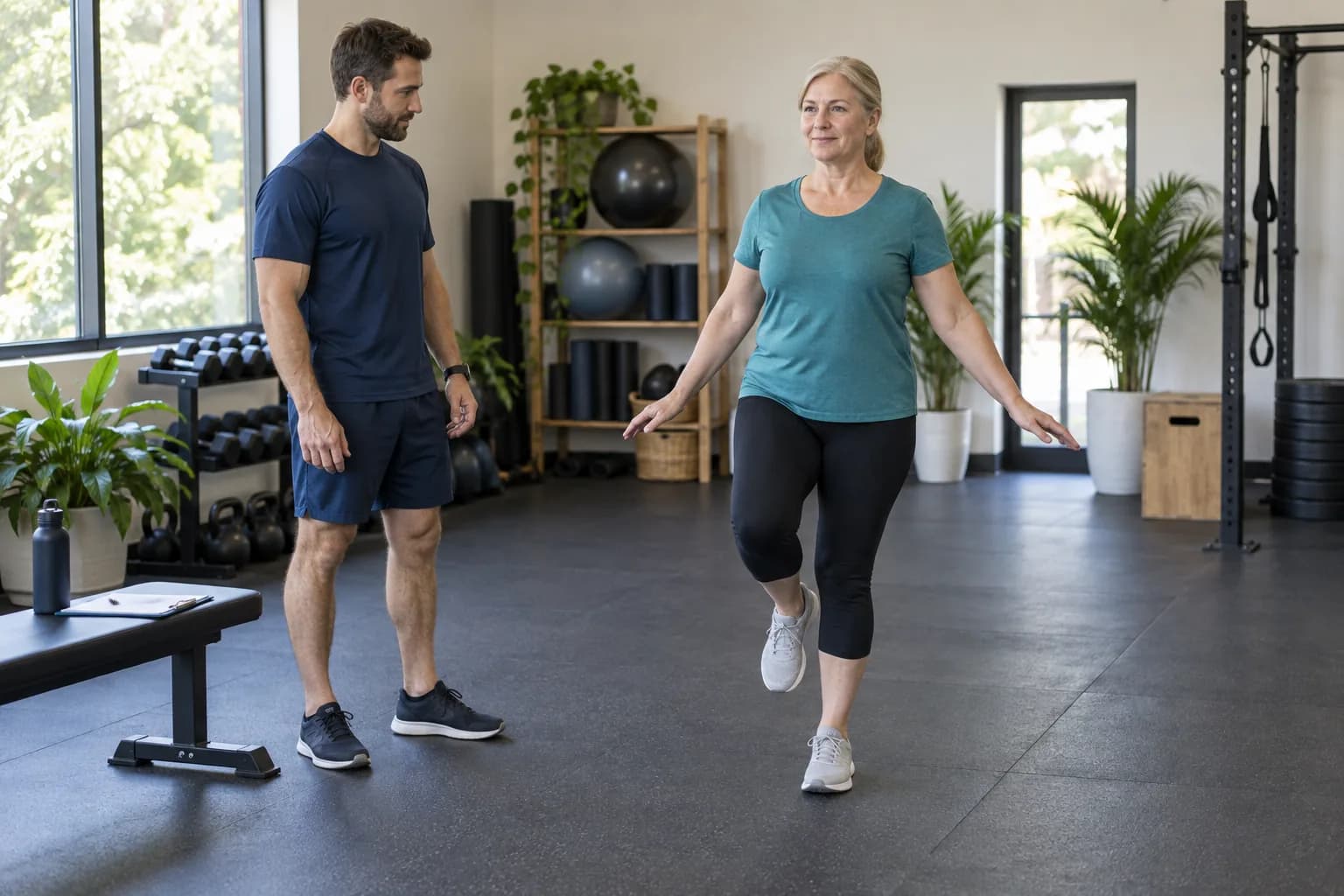
A fitness body assessment is a structured look at how you currently move and what you want to improve. It can help a coach choose an appropriate starting point instead of relying on assumptions. The assessment may include posture observation, mobility, balance, range of motion, movement patterns and a basic strength baseline.
A fitness assessment is not a medical examination or diagnosis. It cannot identify the medical cause of pain or replace evaluation by a qualified healthcare professional. Its purpose is to support exercise planning within the coach’s fitness scope.
Begin with goals and relevant context
Before observing movement, the coach should ask about your goals, current activity, exercise experience, schedule and available equipment. A plan for returning to regular walking may require a different emphasis than a plan for learning resistance exercises. Context helps make the assessment relevant.
Share injuries, symptoms, movement concerns and healthcare guidance that could affect exercise. The coach may pause or modify the assessment and recommend medical clearance when an issue is outside fitness practice. You should also explain which daily or recreational activities you want to perform more comfortably.
Use posture as one piece of information
Posture observation describes how you hold certain positions during the assessment. It may help the coach decide which cues or exercise setups to try, but it should not be used to label your body as damaged or predict pain. People naturally use different positions throughout the day.
The more useful question is whether you can move between positions with control and whether a setup helps you perform an exercise comfortably. Posture is one observation among many, not a grade and not a medical conclusion.
Review mobility and range of motion
Mobility review can show the comfortable range you can actively use at selected joints. The coach may look at ankles, hips, shoulders or the upper back depending on your goals. Movements should be gradual, and support can be added when balance or confidence is a concern.
The assessment does not require forcing the largest possible range. It looks for a useful starting range and how well you control it. If a movement causes sharp pain, numbness, dizziness or another concerning symptom, stop and seek appropriate professional guidance.
Observe balance and movement control
Balance may be reviewed in stable, supported positions before progressing to more challenging tasks. The coach can observe how you shift weight, change direction or maintain a position. A sturdy chair, wall or countertop can help keep the environment appropriate.
Movement control includes pace, coordination and the ability to repeat a pattern consistently. These observations can guide choices such as using a wider stance, reducing range or selecting a supported variation. They do not diagnose neurological, vestibular or orthopedic conditions.
Look at everyday movement patterns
A fitness assessment may include versions of sitting and standing, stepping, reaching, pushing, pulling, hinging or carrying. The exact selection should match your goals and starting ability. There is no need to perform an advanced exercise to create a useful baseline.
The coach may adjust foot position, support, resistance or range and observe whether the movement becomes clearer or more comfortable. This process helps identify teachable starting variations. It is not a search for a perfect body or a reason to avoid movement unnecessarily.
- Use a stable chair for sit-to-stand observation.
- Choose a light resistance for initial pushing or pulling.
- Keep the environment clear during stepping or balance tasks.
Establish a basic strength baseline
A strength baseline may record the variation, resistance and number of controlled repetitions you can perform with an agreed level of effort. For a beginner, body weight, resistance bands or light weights may provide enough information. Quality and comfort are more important than testing a maximum.
The baseline helps the coach choose initial exercises and track future changes. Repeating the same safe task under similar conditions can show whether control, confidence or capacity has changed. Day-to-day variation is normal, so one result should not be treated as a permanent label.
Use the baseline to monitor progress
Assessment findings should lead to practical decisions. The plan might include a supported squat variation, gradual shoulder mobility or balance work near a stable surface. The coach should explain why each priority connects to your goals and how it may progress.
Reassessment can occur after enough consistent practice to make comparison useful. Progress may appear as smoother movement, a more comfortable range, better balance, additional repetitions or greater confidence. If symptoms develop or worsen, stop relying on fitness reassessment and consult an appropriate healthcare professional.
Common questions
Is a fitness body assessment a medical diagnosis?
No. It is a fitness-focused review used to guide exercise planning. Pain, injury and medical concerns require assessment by an appropriately qualified healthcare professional.
Do I need to be fit before an assessment?
No. The assessment should be adapted to your starting ability and can use support, reduced range and beginner-friendly movements.
What should I bring to a body assessment?
Wear clothing and shoes that allow comfortable movement, and bring relevant exercise or healthcare guidance you have been asked to share.